The Powerful Rise of AI in Mathematics: Automated Reasoning, Proof Assistants, and What Comes Next (Part 1)
This is Part 1 of a series examining how AI is transforming mathematical research. Part 1 covers the core contributions in automated theorem proving, proof assistants, and pattern mining, along with the limitations and open debates currently dividing the mathematical community.
A Discipline That Prided Itself on Being Unautomatable
For most of computing history, mathematics was assumed to be the last stronghold that AI would conquer, if it ever could at all. Mathematical proof requires airtight, step by step logical rigor of a kind that resists the probabilistic pattern matching underlying most machine learning systems. Yet in the space of roughly two years, AI in mathematics has moved from a curiosity discussed at specialist workshops to a subject serious enough to warrant a dedicated public lecture at the 2026 International Congress of Mathematicians, delivered by Terence Tao, widely regarded as the most accomplished living mathematician.
Tao’s framing was direct: mathematics, he argued, is entering a second crisis in its foundations, comparable in scale to the crisis triggered by Russell’s paradox and Gödel’s incompleteness theorems a century earlier, except this time the disruption comes from artificial intelligence rather than internal logical contradiction.
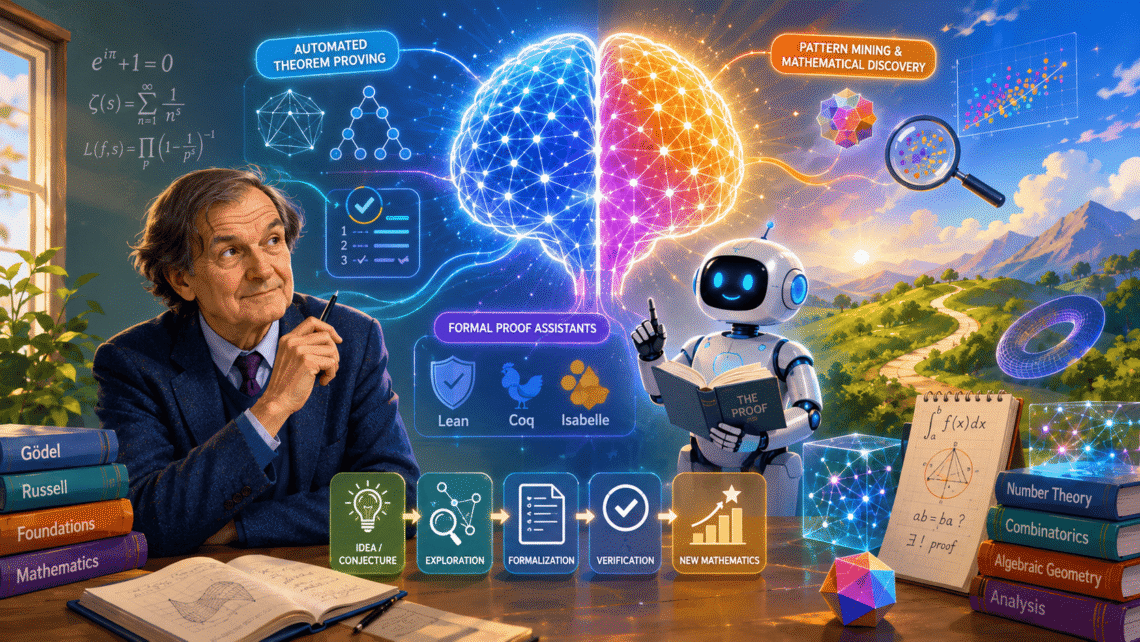
Understanding what AI in mathematics has actually achieved, where it genuinely struggles, and what mathematicians themselves are saying about it requires examining three distinct but interconnected fronts, automated theorem proving, formal proof assistants, and pattern mining across the mathematical literature, each of which has developed at a strikingly different pace.
Automated Reasoning: From Olympiad Silver to Erdős Problems
The most publicly visible achievement of AI in mathematics has come from competition mathematics, precisely because Olympiad problems provide a clean, verifiable benchmark. In 2024, Google DeepMind’s AlphaProof, an AlphaZero inspired reinforcement learning system, combined with AlphaGeometry 2, solved four of six problems at the International Mathematical Olympiad, achieving a score equivalent to a silver medal, the first time any AI system had reached medal level performance at the competition.
AlphaProof trains by learning to find formal proofs through reinforcement learning on millions of auto-formalized problems, and for the hardest cases uses what DeepMind calls test time reinforcement learning, generating and learning from millions of related problem variants at the moment of inference itself, rather than relying purely on pretrained knowledge.
Progress since then has accelerated further. By the 2025 IMO, an advanced Gemini Deep Think framework achieved gold medal level performance, and OpenAI reported a comparable gold medal result from one of its own models. These results moved AI in mathematics from an interesting research direction to a genuine competitive presence in a domain long considered the exclusive preserve of the most gifted young mathematicians in the world.
The frontier has moved beyond Olympiad problems entirely into genuinely unsolved research mathematics. In January 2026, reports emerged that GPT 5.2 Pro, paired with the formalization system Aristotle, generated proofs for two specific Erdős Problems, open questions in number theory that had remained unresolved for years, and crucially, these proofs secured acceptance from Terence Tao himself after careful review. Separately, DeepMind’s AlphaEvolve system collaborated directly with Tao to find new approaches to previously unsolved mathematical problems, demonstrating that AI in mathematics is no longer confined to reproducing known results faster but is beginning to genuinely contribute novel mathematical insight.
Proof Assistants: The Infrastructure That Makes Trust Possible
Running parallel to automated theorem proving is a distinct and arguably more foundational thread of AI in mathematics: formal proof assistants, software systems such as Lean, Coq, and Isabelle that allow mathematical proofs to be written in a machine checkable formal language, verified line by line with the same rigor a computer applies to checking whether a program compiles. Tudor Achim, CEO of Math Inc, captured the significance of this approach starkly: when a formal system outputs a proof, nobody has to look at it, because you know it is correct by construction, addressing what he calls the verification problem, the bottleneck created when AI generates mathematical content faster than humans can check it.
The pace of progress specifically within Lean 4 based formalization has been extraordinary through 2025 and into 2026. HunyuanProver, a model fine tuned specifically for interactive theorem proving, achieved state of the art results on the standard MiniF2F benchmark and successfully proved several genuine IMO level statements. Using a system called Gauss, Math Inc completed a challenge originally set by Terence Tao and mathematician Alex Kontorovich to fully formalize the strong Prime Number Theorem in Lean, a genuinely significant undertaking given the theorem’s depth and historical importance.
Most recently, a system called AxiomProver, working with mathematician Ken Ono, reportedly solved all twelve problems from the 2025 Putnam Competition, widely regarded as the most difficult undergraduate mathematics competition in the United States, and went further, resolving four previously open conjectures that had stumped human mathematicians, including uncovering a connection to nineteenth century Jacobi symbols that had been entirely missed by the human researchers working on the problem.
Tao himself has tracked this progress with characteristic precision, introducing the concept of the de Bruijn factor, a measure of how much additional effort formalizing a proof in Lean requires compared to writing it informally. He estimated this factor at roughly twenty in 2023 and 2024, and noted by late 2025 and into 2026 that rapid advances in autoformalization, AI systems that translate informal mathematical writing directly into formal Lean code, had essentially emptied the queue of unclaimed formalization tasks on at least one major mathematical library project, a striking practical demonstration of how quickly this specific application of AI in mathematics has matured.
Pattern Mining and Mathematical Discovery Beyond Proof
A third and less publicly discussed application of AI in mathematics involves pattern mining and conjecture generation, using machine learning not to prove statements but to discover which statements might be true in the first place, a task that has historically depended on mathematical intuition built over decades of experience. DeepMind’s FunSearch system, which combines large language models with evolutionary program search, discovered new solutions to the cap set problem, a longstanding open question in combinatorics, and produced more effective bin packing algorithms than previously known, genuinely novel mathematical objects rather than reproductions of existing results.
A related system called PatternBoost used pattern recognition across large mathematical datasets to disprove a conjecture that had stood unresolved for thirty years, demonstrating that AI in mathematics can contribute not only proofs of true statements but also counterexamples that overturn long held mathematical beliefs. This lineage traces back to earlier systems such as Graffiti, which pioneered automated conjecture generation decades before the current wave of deep learning made such systems dramatically more capable. Comprehensive surveys of this emerging field now describe mathematical exploration and discovery at scale as a distinct research area in its own right, separate from both automated theorem proving and formal verification, focused specifically on using AI to identify which mathematical questions are worth asking.
Where AI in Mathematics Genuinely Struggles
Despite this rapid progress, mathematicians closest to the technology are notably careful about its current limitations, and Tao’s own analysis is instructive precisely because it avoids both dismissiveness and hype. He draws a sharp and important distinction between Lean as a formal proof assistant versus an automatic theorem prover, noting that Lean formalizes a proof a human has already found, and that on its own it is not all that useful in discovering genuinely new proofs.
The emerging best practice he describes divides labour deliberately: humans author or carefully review the statement of a theorem, since verification only certifies that a formal proof matches a formal statement, not that the formal statement actually captures the mathematician’s real intent, while automation increasingly handles the mechanical work of constructing the proof itself once the statement is correctly specified.
This human review bottleneck remains genuinely unresolved. As Tao and his co-author Tanya Klowden note in their 2026 preprint on mathematical methods in the age of AI, there are serious concerns that entire areas of academic mathematical discourse could be drowned out by a flood of low quality AI generated content, echoing a concern raised independently by mathematician Vladimir Voevodsky years earlier, that a technically dense argument by a trusted author, difficult to check and superficially similar to arguments already known to be correct, is hardly ever checked in careful detail, a human trust shortcut that becomes considerably more dangerous once AI can generate such arguments at essentially unlimited scale.
There is also a genuine philosophical unease circulating within the mathematical community that goes beyond technical limitation. Discussions at academic seminars, including a Fall 2025 mathematics and AI course at the University of Washington, have raised pointed questions that Tao’s own lecture explicitly grapples with: does mathematics lose value when computers become better at it than humans, is there an enfeeblement risk in incorporating AI into mathematical training and education, and should foundational skills such as long division or manual integration still be taught if AI in mathematics can perform them instantly and flawlessly.
Tao’s own answer, delivered at the ICM lecture, was that mathematicians need to articulate far more clearly what goals mathematical research is actually meant to serve, arguing that theorem proving and problem solving alone were never the complete picture of why mathematicians do mathematics in the first place, and that this question has become newly urgent precisely because AI has begun to threaten the sufficiency of the old, implicit answer.
Conclusion
AI in mathematics has progressed, in the space of roughly two years, from solving Olympiad geometry problems to contributing genuine proofs accepted by Terence Tao for previously open questions in number theory, while formal proof assistants have simultaneously matured into infrastructure capable of verifying mathematical claims with a rigor no individual human reviewer can match at scale. Pattern mining systems have begun generating and disproving conjectures independently, adding a third distinct capability to the toolkit.
Yet the mathematicians working closest to these systems remain measured rather than triumphant, emphasizing that formal verification certifies correctness against a stated formal claim, not that the claim itself captures genuine mathematical intent, and that the deeper question of what mathematical research is actually for has become considerably more pressing than the narrower question of what AI can currently compute.


You May Also Like
The Powerful History of Code Review: From Fagan Inspections to the Age of AI Agents
The Critical Truth About LLM Development History: A Decade of Progress Without the Hype (Part 1)