
AI News & Industry Updates
Stay informed about the latest developments in artificial intelligence, generative AI, machine learning, AI agents, new model releases, industry trends, research breakthroughs, and technology innovations shaping the future of work and business.
-
How AI Is Changing Healthcare: Diagnosis, Drug Discovery, and Patient Care
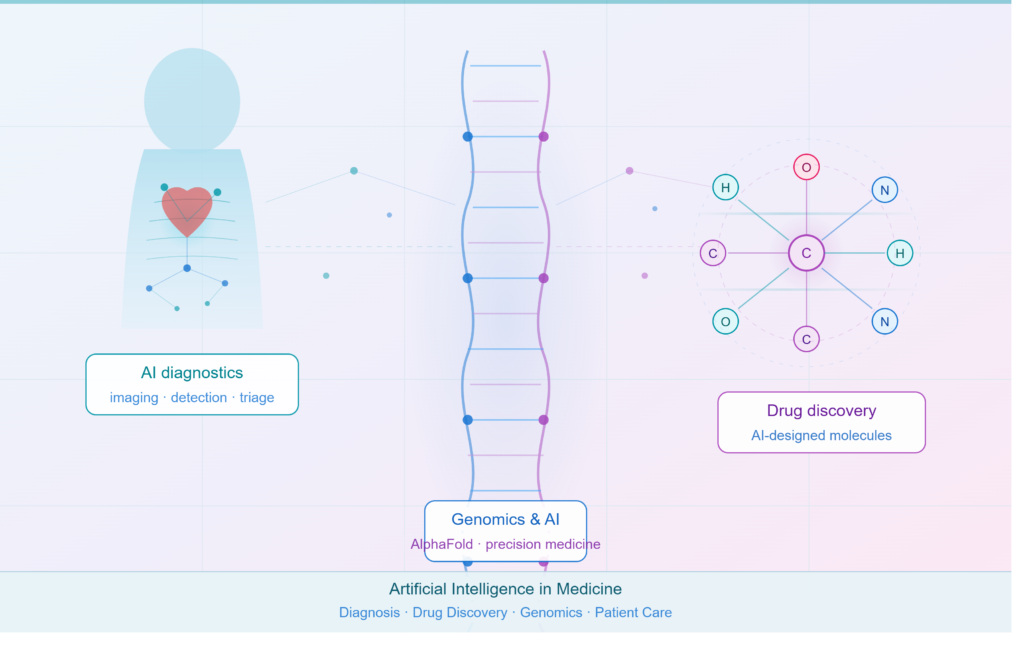
Medicine’s Quiet Revolution
Healthcare has always advanced in waves, examples being germ theory, antibiotics, the randomised controlled trial, genomic sequencing. Each wave took decades to become standard practice. Artificial intelligence is different. The pace at which AI tools have moved from research papers to clinical wards has compressed that timeline dramatically, and the breadth of the transformation, including touching diagnostics, drug development, genomics, and patient management simultaneously, has no obvious historical parallel.
This is not hype at distance. It is measurable, already underway, and raising genuinely difficult questions about how medicine will be practised, validated, and governed in the decade ahead.
Seeing What Human Eyes Miss: AI in Medical Imaging
The area where AI has achieved the most clinically validated impact is medical imaging. As of December 2025, over 1,300 AI-enabled medical devices have received FDA marketing authorisation, with 1,039 specifically for radiology — accounting for roughly 80% of all approved AI medical tools. These are not experimental prototypes; they are deployed daily in hospitals across the United States, Europe, and Asia.
The performance numbers are striking. Deep learning models can identify tumours, strokes, and fractures within seconds, with real-world studies demonstrating up to 17.6% higher breast cancer detection rates. In stroke treatment, where neurological damage accumulates with every passing minute, AI has reduced door-to-treatment intervals by as much as 30 minutes, with measurable improvements in survival rates and patient outcomes.
The mechanism is convolutional neural networks trained on tens of millions of labelled scans. These networks learn to identify statistical patterns in pixel distributions that correlate with pathology — patterns that may be too subtle or spatially diffuse for a human radiologist under time pressure to consistently detect. In breast cancer screening specifically, AI-assisted interpretations have lowered false negatives by almost 9% and decreased unnecessary recall rates — reducing both missed cancers and patient anxiety from false alarms simultaneously.
The caveat is important. AI is not a substitute for doctors: it can make mistakes or generate false positives, and over-reliance risks impairing clinicians’ skills. The clinical consensus, reflected in nearly every major radiology society’s guidance, is that AI functions best as a co-pilot — triaging the scan queue, flagging anomalies for human review, and performing automated measurements — while the radiologist retains diagnostic authority.
The AlphaFold Moment: Rewriting Drug Discovery
If imaging AI represents evolutionary improvement in existing workflows, AlphaFold represents something more fundamental: a solution to a problem that had defeated biology for half a century.
Proteins fold from linear amino acid chains into precise three-dimensional structures that determine their function. Predicting that structure from sequence alone — the protein folding problem — was considered one of the hardest open problems in science. Google DeepMind’s AlphaFold 2, published in Nature in 2021, solved it with accuracy comparable to experimental methods. Its creators Demis Hassabis and John Jumper were awarded the 2024 Nobel Prize in Chemistry for the work. By November 2025, AlphaFold was being used by over three million researchers across more than 190 countries, tackling problems including antimicrobial resistance, crop resilience, and heart disease.
AlphaFold 3, released in 2024, extended the capability beyond proteins to predict the structure and interactions of DNA, RNA, ligands, and small molecules — with at least a 50% improvement over existing methods for protein-molecule interactions, and doubled prediction accuracy for some drug-relevant interaction categories. For drug discovery, this is transformative. The traditional pipeline required experimental determination of a target protein’s structure — a process taking months or years — before rational drug design could begin. AlphaFold collapses that step to hours.
The pharmaceutical industry has responded at scale. A landmark development at the 2026 J.P. Morgan Healthcare Conference was a $1 billion co-innovation lab announced by Nvidia and Eli Lilly, aimed at creating a continuous learning system connecting agentic wet labs with computational dry labs around the clock. AstraZeneca, Bristol Myers Squibb, Roche, and Recursion Pharmaceuticals have all announced multi-hundred-million-dollar AI drug discovery partnerships in the same period.
The critical open question is clinical validation. The most advanced AI-designed drugs are now entering Phase III pivotal trials in 2026, with multiple clinical readouts expected throughout the year — the first large-scale test of whether AI genuinely improves success rates beyond the pharmaceutical industry’s persistent 90% clinical trial failure rate. Computational elegance and clinical efficacy are not the same thing. The next two years will determine whether the investment thesis is justified.
Genomics, Precision Medicine, and the Individual Patient
Beyond imaging and drug design, AI is enabling a more fundamental shift in how medicine conceptualises the patient. Traditional medicine treats populations — a drug is approved because it outperforms placebo in a trial of thousands. Precision medicine asks a different question: which treatment is most likely to work for this specific patient, given their genetic profile, biomarkers, and disease subtype?
AI-powered clinical decision support systems are stepping into the gap created by the rapid and unmanageable expansion of medical knowledge. Platforms like OpenEvidence, among the most widely adopted decision support tools in US medicine, allow physicians to rapidly search medical literature, synthesise findings, and check drug interactions at the point of care.
In genomics, models trained on population-scale genetic databases can now identify disease-causing variants with a precision that was impossible using statistical methods alone. These systems can speed up genetic diagnosis for rare and complex illnesses by frequently ranking the true disease-causing mutation within the top ten candidates, and guide personalised treatment by linking genetic variants directly to their expected clinical manifestations.
The combination of genomic data, electronic health records, and AI-driven pattern recognition is creating what researchers describe as a “learning health system” — one in which every patient encounter generates data that improves predictions for the next patient with a similar profile. This is medicine learning from itself at a scale and speed that no previous generation of clinicians could achieve.
The Governance Problem
The pace of deployment has outrun the pace of regulation, and the gap is generating legitimate concern. Roughly 200 state AI bills are being tracked in 2026 alone, and 83% of polled healthcare workers say AI needs more regulation — reflecting broad industry support for clearer governance frameworks even as the federal government takes a largely deregulatory stance.
The EU AI Act’s high-risk provisions, which take effect August 2026, classify AI systems used in medical diagnosis and drug development as high-risk — requiring conformity assessments, transparency obligations, and human oversight mechanisms. The US approach remains more fragmented, relying primarily on the FDA’s device authorisation framework, which does not require rigorous clinical validation — FDA clearance alone does not guarantee real-world effectiveness.
The algorithmic bias problem deserves specific attention. AI systems trained predominantly on data from specific demographic groups — which describes most current medical AI, given the historical composition of clinical trial populations — can perform significantly worse for underrepresented groups. A model that detects diabetic retinopathy with 95% accuracy on one ethnic population may perform at 80% on another, with no visible signal in aggregate accuracy statistics that a problem exists.
What Comes Next
The trajectory of AI in healthcare points toward three developments that are likely to define the next decade. Multimodal AI — systems that integrate imaging, genomics, clinical notes, and wearable sensor data simultaneously — will produce risk models and diagnostic tools with a richness that no single-modality system can match. Agentic AI in clinical workflows will handle administrative burden, prior authorisation, documentation, and care coordination autonomously, returning clinician time to patients. And AI-designed therapeutics will, if the current Phase III trials vindicate the approach, fundamentally alter the economics of bringing new drugs to market.
None of this makes medicine easier. It makes it more capable and correspondingly more demanding of the humans who must govern, validate, and take clinical responsibility for what these systems produce. That, ultimately, is where the most important work remains to be done.
-
DeepSeek: The $6 Million Model That Shook Wall Street and Challenged the AI Establishment
A Startup Nobody Saw Coming
In the summer of 2023, a hedge fund manager in Hangzhou, China, quietly spun off an AI research lab. By January 2025, that lab had triggered what CBS News described as a shockwave through Wall Street, briefly dethroned ChatGPT as the most downloaded free app on Apple’s App Store, and forced a fundamental reassessment of the assumptions underlying hundreds of billions of dollars in AI infrastructure investment. The company was DeepSeek. The model was R1. And nothing in the AI industry looked quite the same afterward.
For enterprise AI leaders evaluating model strategy, AI governance, and infrastructure spending, understanding DeepSeek is not optional. It is a case study in how architectural innovation can disrupt market assumptions, and a live stress test of every claim that frontier AI requires frontier compute budgets.
How DeepSeek Actually Works
DeepSeek is built on the same transformer foundation that underlies GPT-4, Claude, and Llama — but with two architectural decisions that distinguish it fundamentally from the models it competes with.
The first is the Mixture-of-Experts (MoE) architecture. DeepSeek-V3 has 671 billion total parameters but only activates approximately 37 billion for any given query. This routs each input through only the most relevant subset of the model’s capacity. This “sparse activation” approach means the compute cost per inference is a fraction of what a dense 671B model would require, while retaining the representational capacity of the full parameter count.
The second is a deeply optimised training pipeline. DeepSeek achieved state-of-the-art benchmark performance using only 2.8 million H800 GPU hours of training time, approximately ten times less training compute than the similarly performing Llama 3.1 405B. The $6 million training cost figure that broke investors’ assumptions is a consequence of this efficiency, not a trick.
DeepSeek-R1, released in January 2025, is based on DeepSeek-V3 and is focused on advanced reasoning tasks, directly competing with OpenAI’s o1 model in performance while maintaining a significantly lower cost structure. Like the o-series models, R1 uses extended chain-of-thought reasoning — generating an internal scratchpad before committing to a final answer — to dramatically improve performance on mathematics, code, and logical inference tasks.
The third structural difference is perhaps the most commercially significant: all DeepSeek models are released under open-weight licences such as MIT for R1, Apache 2.0 for subsequent releases. OpenAI’s models are fully proprietary. Anthropic’s models are fully proprietary. DeepSeek publishes the weights for free. Any enterprise can download and self-host the model at zero per-token cost.
Does It Actually Work?
The honest answer is: yes, significantly. But with important caveats.
On reasoning benchmarks, R1 was legitimately competitive with OpenAI’s o1 at launch. Its mathematical reasoning in particular was rated best-in-class by several independent evaluations. For code generation, structured analysis, and multilingual tasks, it performs at a level that rivals or exceeds models costing orders of magnitude more to run via API.
The limitations are real, however. According to testing by Vectara, DeepSeek-R1 hallucinates at a rate of 14.3%, compared to approximately 2% for OpenAI’s GPT-4. Its safety guardrails are also notably weaker than those of Western frontier models: Palo Alto Networks found it is relatively easy to bypass DeepSeek’s safety guardrails, and Enkrypt AI reported that R1 is four times more likely to produce malware or insecure code than OpenAI’s o1.
For enterprise deployment, this matters. A model that performs exceptionally on benchmarks but hallucinates at seven times the rate of its main competitor and fails adversarial testing is not a drop-in replacement for production workflows where reliability and safety alignment are contractual or regulatory requirements.
The Market Shock: DeepSeek Monday
The broader AI industry was unprepared for what happened on January 27, 2025. Nvidia’s stock dropped nearly 18% that Monday morning, now referred to as “DeepSeek Monday” on Wall Street. Roughly $600 billion in market value evaporated in a single trading session, the largest single-day loss for any company in stock market history. Microsoft, Alphabet, Broadcom, and ASML all fell in sympathy. By the end of the week, over $1 trillion had been erased from American tech stocks.
The mechanism of the panic was straightforward: if a Chinese lab could produce a frontier-capable model for $6 million, the foundational investment thesis driving demand for Nvidia’s chips — that training frontier AI requires tens of thousands of the most expensive GPUs available — appeared to be falsified in one announcement.
Nvidia CEO Jensen Huang pushed back directly. As TechCrunch reported, Huang called DeepSeek’s R1 “incredibly exciting” and argued the market had it exactly backwards: more efficient models lower the cost of AI deployment, which accelerates adoption, which increases aggregate demand for compute. That argument proved correct. Nvidia’s shares are up 58% since the DeepSeek selloff, and its growth rate has continued to defy expectations. The panic was real; the underlying catastrophe was not.
The Controversies
DeepSeek’s emergence generated controversy on multiple fronts simultaneously, and none of them have been cleanly resolved.
Data privacy. DeepSeek notes in its privacy policy that personal information it collects from users is held on secure servers located in the People’s Republic of China. Under that policy, the company collects device model, operating system, keystroke patterns or rhythms, IP address, and system language. Chinese law grants Beijing broad authority to access data from companies based in China — the same legal structure that made TikTok a Congressional target. For enterprise users handling sensitive data, this is a non-negotiable concern.
Censorship. A CBS News analysis of the application found that DeepSeek did not return any results for a prompt seeking information about the 1989 Tiananmen Square protests and subsequent massacre. The model also declined to answer questions about the Uyghur situation and Taiwan’s political status, while providing detailed answers about criticisms of Western political figures. This ideological alignment is baked into the base model’s training, not merely a surface-level filter.
Distillation allegations. OpenAI told the Financial Times that it had seen evidence that its models were used by DeepSeek to train its own — which would be a breach of OpenAI’s terms of service. White House AI czar David Sacks said there was “substantial evidence” that DeepSeek had “distilled the knowledge out of OpenAI’s models.” DeepSeek has not publicly addressed the allegation in detail, and the legal status of model distillation remains an unresolved question across the industry.
Chip access. DeepSeek built its models using Nvidia H800 GPUs and these chips are designed specifically for the Chinese market after the US banned exports of the more powerful H100 and A100 chips in late 2022. In a September 2025 Nature paper, DeepSeek acknowledged it also owns A100 chips used for early-stage experiments. US officials have alleged access to restricted hardware acquired after export controls took effect, though Nvidia has maintained that DeepSeek’s use of its technology was export-control compliant.
What This Means for Enterprise AI Strategy
DeepSeek’s net contribution to the enterprise AI landscape is a genuinely mixed signal. It proved that architectural efficiency, and not raw compute, is the binding constraint on frontier model quality, which is a productive finding for the whole field. It demonstrated that open-weight frontier models are viable, which expands the strategic options available to enterprises that want to self-host rather than depend on API access.
But anyone handling sensitive business data should not use the DeepSeek app or API directly — and the hallucination rate and safety posture make it unsuitable for high-stakes production workflows without significant additional investment in evaluation and guardrails. For research, mathematics, and coding tasks in non-sensitive environments, the open-weight models offer exceptional performance at zero per-token cost.
The deeper strategic lesson is one DeepSeek did not intend to teach: that the efficiency frontier in AI is far from exhausted, that architectural innovation can close capability gaps that compute alone cannot, and that the assumption that building frontier AI requires a $100 million training budget was always more fragile than the market priced it to be.
-
When the AI Boom Meets Reality: Understanding the June 2026 Stock Selloff
A Turbulent Week for AI Stocks
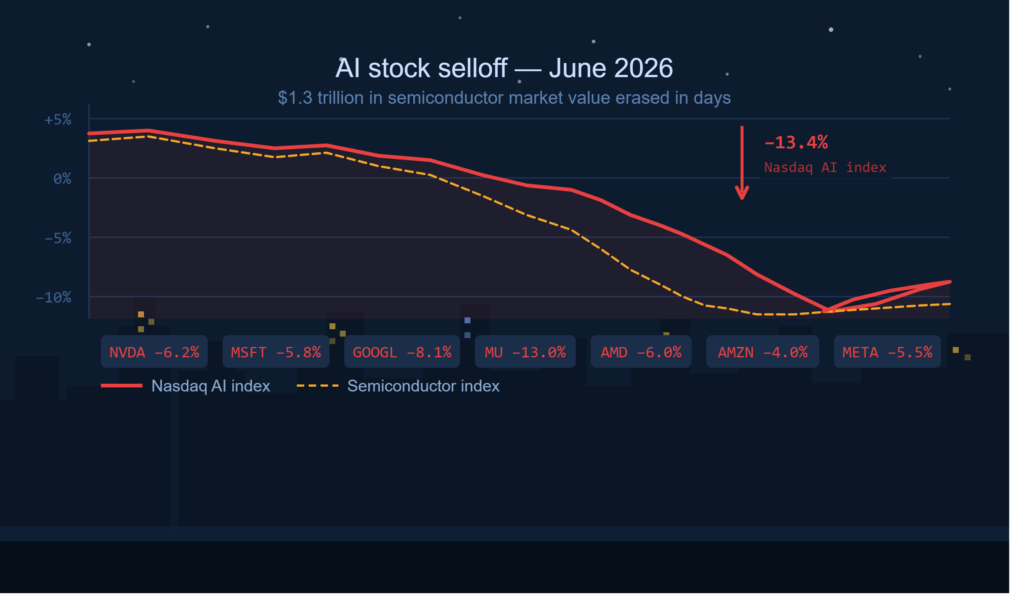
The artificial intelligence sector has been one of the most exciting investment stories of the past several years. But in late June 2026, the mood shifted sharply. On June 23–24, 2026, the tech-heavy Nasdaq dropped 2.21% and the S&P 500 fell 1.44%, as investors sold semiconductor and AI-related shares broadly. The impact did not stay confined to Wall Street. South Korea’s Kospi index tumbled 10%, tripping a circuit breaker (an automatic 20-minute trading halt) with memory chipmakers SK Hynix and Samsung each falling more than 12%.
In total, semiconductor stocks shed more than $1.3 trillion in market value during this correction. For many observers, the question became urgent: is this the beginning of an AI bubble bursting, or simply a market pausing to catch its breath?
What Triggered the Selloff?
There was no single dramatic event that caused the drop. Instead, several slow-building pressures converged at once.
Spending without proof of returns. The most fundamental concern driving the selloff is a straightforward one. Combined 2026 capital expenditures across Microsoft, Alphabet, Amazon, and Meta exceeded $452 billion, while free cash flow at these companies declined dramatically. Investors who were once content to fund AI’s promise are now demanding evidence of profit. Goldman Sachs’s equity research head James Covello summarised the mood bluntly: “At some point, you’ve got to make money.” Enterprise surveys in 2025–2026 found that 95% of corporate AI projects delivered no measurable return.
Talent departures rattled confidence. High-profile AI talent departing from Google DeepMind to competitors, including Nobel Prize-winning researcher John Jumper to Anthropic, and Gemini co-lead Noam Shazeer to OpenAI. And these departures raised questions about competitive advantages, wiping $270 billion from Alphabet’s market cap.
Cautious guidance from chip companies. Broadcom’s Q3 AI chip sales guidance of $16 billion fell short of the $17.2 billion analyst estimate, and the company notably did not raise its full-year AI semiconductor forecast. This triggered a “sell-the-news” reaction, sending Broadcom shares down 14% and creating a ripple effect across the entire chip supply chain.
Valuation fatigue. AI stock valuations had been flying high for several years, built mainly on the technology’s promise rather than the bottom-line profit growth that fuels most companies’ stock price increases. After nine consecutive weeks of gains for the S&P 500, profit-taking was inevitable.
Correction, Not Collapse
It is important to keep this in perspective. Most analysts describe June 2026 as a correction rather than a crash. Tech earnings are still growing, and the Nasdaq remains up 10% for the year despite the selloff.
Micron Technology, the memory and storage chipmaker, surged nearly 16% after reporting stellar earnings, driven by the boom in demand for its semiconductors. That tells a more nuanced story: the underlying demand for AI infrastructure has not disappeared. What has changed is investors’ patience for returns on that investment.
Implications for the AI Industry
This market correction carries several important signals for anyone building in or investing around AI.
Monetisation is now the priority. The era of rewarding AI companies simply for spending boldly is ending. Businesses that can demonstrate clear, measurable returns from their AI investments will attract continued support. Those with vague AI strategies face sustained pressure.
Smaller and open-source models gain relevance. Some analysts argue that AI-related stock prices are falling in tandem with the cost of compute, as more companies question whether frontier models from OpenAI and Anthropic justify the premium when a reliable, lower-cost model may meet their needs perfectly well.
IPO timelines may shift. OpenAI is reportedly considering delaying its IPO because of recent market volatility, which could make it harder for the company to achieve its desired $1 trillion valuation.
Global ripple effects. When hyperscalers pour hundreds of billions into AI data centres, they compete for the same memory chips and components that consumer electronics also need, meaning the AI investment boom is one reason your next PC upgrade costs more than your last one.
What This Means for Learners and Builders
For students and professionals building skills in AI engineering, this correction is not a reason for concern; it is rather a reason to focus. Markets are not rejecting AI; they are demanding that AI deliver. That shift creates a clear opportunity for people who can build practical, results-driven AI solutions rather than theoretical demonstrations.
The companies and professionals who will thrive in the next phase of AI are those who can answer one question clearly: what problem does this solve, and how does it create measurable value? That question has always mattered. Now, the market is insisting on an answer.
-
OpenAI’s $852 Billion Valuation: What It Means for the Future of AI
The Biggest Bet in Tech History
Artificial Intelligence has seen no shortage of headline-grabbing moments over the past few years, but one development from mid-2026 stands apart from the rest. OpenAI closed its largest funding round to date, raising $122 billion at an $852 billion valuation, with major investments from Amazon, NVIDIA, and SoftBank leading the round. To put that number in perspective, $852 billion places OpenAI among the most valuable companies ever created, surpassing the market capitalisation of most nations’ largest corporations and approaching the GDP of entire economies.
This is not just a story about one company raising money. It is a signal about where the technology industry believes the next decade of value creation is headed.
What Is Driving the Valuation?
Numbers this large demand context. OpenAI’s valuation is grounded in real and rapidly growing business metrics. The company reported $2.6 billion in monthly revenue, 900 million ChatGPT weekly active users, and signaled plans for a potential IPO later in the year. Those figures represent extraordinary growth for a company that barely had a commercial product three years ago.
OpenAI also filed a confidential S-1 with the SEC, setting the stage for what would be a landmark public offering. If and when that IPO proceeds, it would be one of the most significant listings in technology history. It will be comparable to the early public offerings of Google, Facebook, and Amazon in their respective eras.
The investment itself reflects a broader industry conviction: that AI is not a feature being bolted onto existing businesses, but an entirely new technological layer that will underpin nearly every sector of the global economy.
Who Is Investing and Why It Matters
The identity of OpenAI’s investors tells its own story. Amazon, NVIDIA, and SoftBank are not passive financial bettors. Each has a strategic reason to be deeply embedded in OpenAI’s future.
Amazon’s $50 billion commitment ties OpenAI to AWS infrastructure, positioning Amazon’s cloud platform as a primary delivery mechanism for AI services at global scale. NVIDIA’s involvement aligns the world’s dominant AI chip maker with the world’s most widely used AI platform. SoftBank brings both capital and distribution reach across Asia and beyond.
For AI engineers and developers, this alignment matters practically. It signals continued investment in the APIs, tools, and infrastructure that power the applications being built today. When the companies funding AI infrastructure are also the companies building the chips and cloud platforms, the ecosystem becomes more integrated, more capable, and, in theory, more accessible.
Potential Impacts: What Changes From Here?
A funding event of this scale has ripple effects that extend well beyond OpenAI’s own products. Here is where those effects are likely to be felt most strongly.
Accelerated competition. When one company commands an $852 billion valuation, rivals respond. Expect Google DeepMind, Anthropic, Meta AI, and emerging players to accelerate their own timelines, hire aggressively, and push model capabilities forward faster than they otherwise would. This competition ultimately benefits developers and end users through better models and lower prices.
Regulatory pressure. Companies valued at this level attract government attention. AI governance conversations that have moved slowly are likely to pick up urgency. The Colorado Consumer Protections for Artificial Intelligence Act, which took effect June 30, 2026, and the proposed federal Great American AI Act are early indicators of a regulatory environment that is beginning to formalise around AI at scale. A publicly traded OpenAI would face scrutiny from securities regulators as well, bringing a new layer of accountability to AI development.
Talent and opportunity. Enormous capital flowing into AI creates enormous demand for people who can build with it. For students and professionals developing AI engineering skills today, the timing could not be better. The gap between organisations that have AI deeply embedded in their operations and those still exploring it is widening; and closing that gap requires skilled builders.
Broader access. Counterintuitively, high valuations often drive down end-user costs. The pressure to grow revenue at a scale that justifies an $852 billion valuation pushes companies to reach more users, expand into new markets, and make their tools more affordable and accessible to individuals, small businesses, and developers worldwide.
The Perspective
OpenAI’s $122 billion funding round is more than a financial milestone. It is a declaration that artificial intelligence has moved from an experimental technology to a foundational economic force. Whether you are a developer building AI applications, a business leader evaluating AI strategy, or a learner just beginning to explore this field, understanding what this moment represents helps you make smarter decisions about where to invest your time and energy.
The question is no longer whether AI will reshape industries. It is whether you will be ready to shape it yourself.