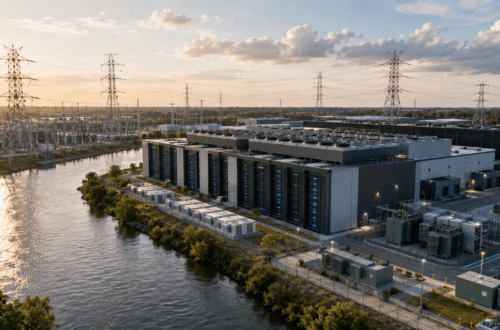
When the AI Boom Meets Reality: Understanding the June 2026 Stock Selloff
A Turbulent Week for AI Stocks
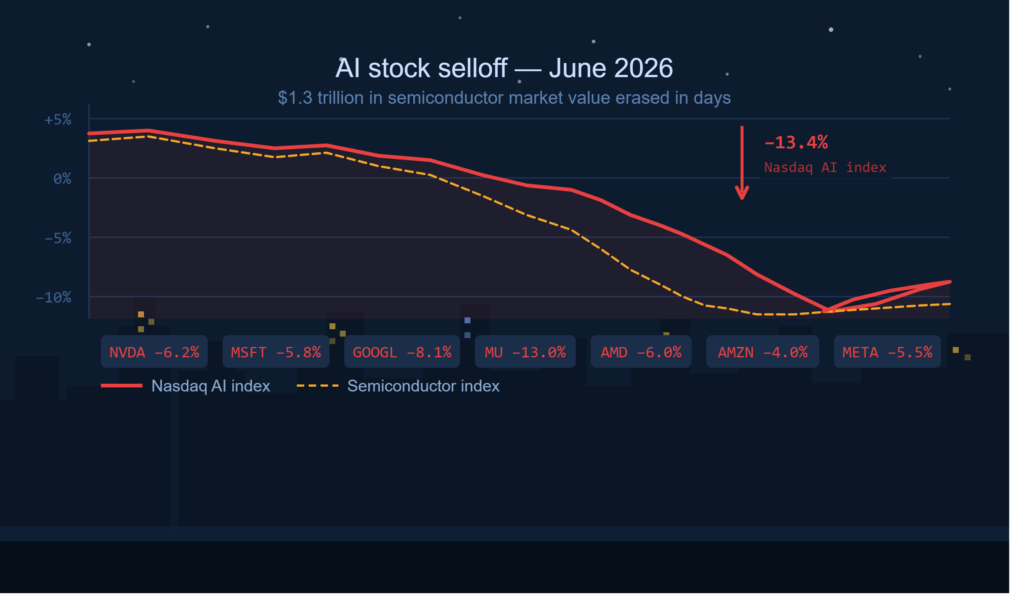
The artificial intelligence sector has been one of the most exciting investment stories of the past several years. But in late June 2026, the mood shifted sharply. On June 23–24, 2026, the tech-heavy Nasdaq dropped 2.21% and the S&P 500 fell 1.44%, as investors sold semiconductor and AI-related shares broadly. The impact did not stay confined to Wall Street. South Korea’s Kospi index tumbled 10%, tripping a circuit breaker (an automatic 20-minute trading halt) with memory chipmakers SK Hynix and Samsung each falling more than 12%.
In total, semiconductor stocks shed more than $1.3 trillion in market value during this correction. For many observers, the question became urgent: is this the beginning of an AI bubble bursting, or simply a market pausing to catch its breath?
What Triggered the Selloff?
There was no single dramatic event that caused the drop. Instead, several slow-building pressures converged at once.
Spending without proof of returns. The most fundamental concern driving the selloff is a straightforward one. Combined 2026 capital expenditures across Microsoft, Alphabet, Amazon, and Meta exceeded $452 billion, while free cash flow at these companies declined dramatically. Investors who were once content to fund AI’s promise are now demanding evidence of profit. Goldman Sachs’s equity research head James Covello summarised the mood bluntly: “At some point, you’ve got to make money.” Enterprise surveys in 2025–2026 found that 95% of corporate AI projects delivered no measurable return.
Talent departures rattled confidence. High-profile AI talent departing from Google DeepMind to competitors, including Nobel Prize-winning researcher John Jumper to Anthropic, and Gemini co-lead Noam Shazeer to OpenAI. And these departures raised questions about competitive advantages, wiping $270 billion from Alphabet’s market cap.
Cautious guidance from chip companies. Broadcom’s Q3 AI chip sales guidance of $16 billion fell short of the $17.2 billion analyst estimate, and the company notably did not raise its full-year AI semiconductor forecast. This triggered a “sell-the-news” reaction, sending Broadcom shares down 14% and creating a ripple effect across the entire chip supply chain.
Valuation fatigue. AI stock valuations had been flying high for several years, built mainly on the technology’s promise rather than the bottom-line profit growth that fuels most companies’ stock price increases. After nine consecutive weeks of gains for the S&P 500, profit-taking was inevitable.
Correction, Not Collapse
It is important to keep this in perspective. Most analysts describe June 2026 as a correction rather than a crash. Tech earnings are still growing, and the Nasdaq remains up 10% for the year despite the selloff.
Micron Technology, the memory and storage chipmaker, surged nearly 16% after reporting stellar earnings, driven by the boom in demand for its semiconductors. That tells a more nuanced story: the underlying demand for AI infrastructure has not disappeared. What has changed is investors’ patience for returns on that investment.
Implications for the AI Industry
This market correction carries several important signals for anyone building in or investing around AI.
Monetisation is now the priority. The era of rewarding AI companies simply for spending boldly is ending. Businesses that can demonstrate clear, measurable returns from their AI investments will attract continued support. Those with vague AI strategies face sustained pressure.
Smaller and open-source models gain relevance. Some analysts argue that AI-related stock prices are falling in tandem with the cost of compute, as more companies question whether frontier models from OpenAI and Anthropic justify the premium when a reliable, lower-cost model may meet their needs perfectly well.
IPO timelines may shift. OpenAI is reportedly considering delaying its IPO because of recent market volatility, which could make it harder for the company to achieve its desired $1 trillion valuation.
Global ripple effects. When hyperscalers pour hundreds of billions into AI data centres, they compete for the same memory chips and components that consumer electronics also need, meaning the AI investment boom is one reason your next PC upgrade costs more than your last one.
What This Means for Learners and Builders
For students and professionals building skills in AI engineering, this correction is not a reason for concern; it is rather a reason to focus. Markets are not rejecting AI; they are demanding that AI deliver. That shift creates a clear opportunity for people who can build practical, results-driven AI solutions rather than theoretical demonstrations.
The companies and professionals who will thrive in the next phase of AI are those who can answer one question clearly: what problem does this solve, and how does it create measurable value? That question has always mattered. Now, the market is insisting on an answer.
You May Also Like
3 Alarming Environmental Costs of AI: Data Centers, Drought, and Community Backlash
Is OpenAI Pricing Power Collapsing Fast? The Alarming Truth Behind the 80 Percent Cut