
The Powerful Nvidia LLM Impact and its 5-Year Reign
The Chip Nobody Saw Coming
In May 2020, Nvidia announced a GPU built for data centers, not gaming rigs. Few people outside chip design circles paid much attention. That chip was the A100. Within three years, it became the single piece of hardware most responsible for the modern LLM boom. Understanding Nvidia LLM impact over the past five to ten years means tracing a story that runs through silicon design, software lock-in, and finally, staggering financial engineering. Each stage built directly on the one before it.
The A100: The GPU That Trained GPT-3
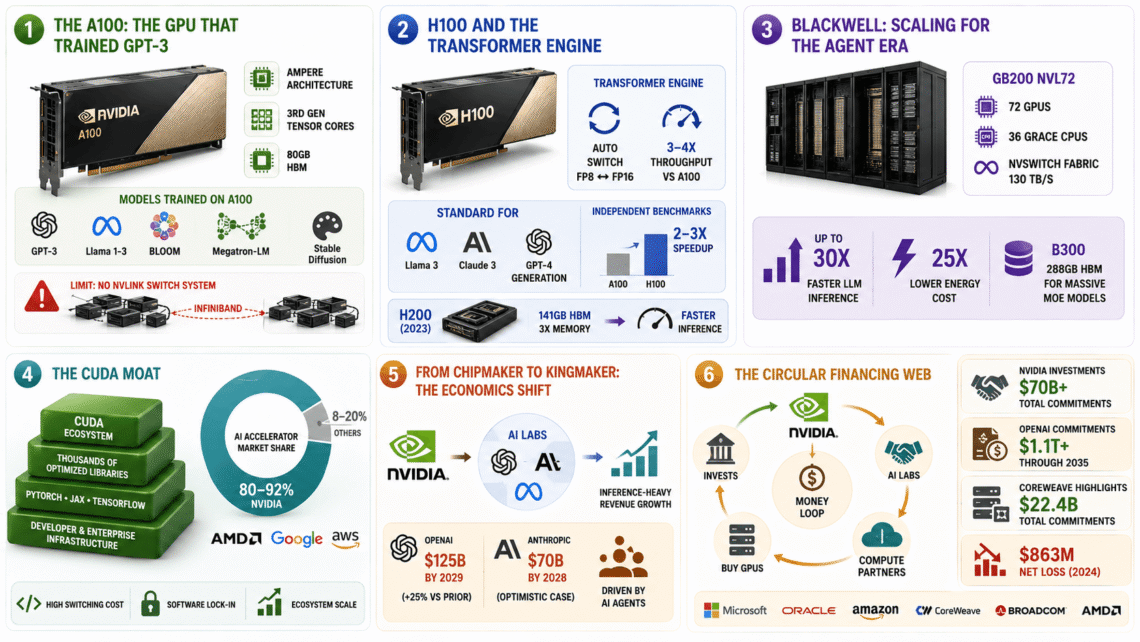
The A100 paired the Ampere architecture with third-generation Tensor Cores and 80 gigabytes of high-bandwidth memory. It shipped in volume through 2024. That alone tells you how long its influence lasted.
But the real story is what got trained on it. GPT-3, Megatron-LM, BLOOM, the first three generations of Llama, and the original Stable Diffusion all ran on A100 clusters. GPT-4 itself was reportedly trained on tens of thousands of A100 GPUs. This was the chip that turned large language models from a research curiosity into a commercial category. Nvidia LLM impact effectively begins here.
The A100 had limits, though. It predated Nvidia’s NVLink Switch System. Scaling past eight GPUs meant routing traffic over InfiniBand, and latency jumped by five to ten times at that boundary. Clusters behaved like islands rather than one unified system. This specific bottleneck is why frontier labs moved off the A100 starting in 2023.
H100 and the Transformer Engine
Nvidia’s answer arrived in 2022. The H100, built on the Hopper architecture, introduced something specifically designed for transformer workloads: the Transformer Engine. It automatically switched between FP8 and FP16 precision during training, without manual tuning. For transformer models specifically, this delivered three to four times the throughput of the A100.
This is where Nvidia LLM impact shifts from raw capacity to genuine architectural specialization. The H100 was not just a faster GPU. It was a GPU designed around the specific mathematical patterns that define transformer training. It became the standard hardware for Llama 3, Claude 3, and the GPT-4 generation of models. Independent benchmarking from MosaicML, a company with no reason to favor Nvidia’s own marketing, confirmed genuine two to three times speedups on real training workloads.
The H200 followed in 2023 as a memory-focused refresh, tripling HBM capacity to 141 gigabytes without changing the compute engine. This mattered because LLM inference is often memory-bound, not compute-bound. More memory bandwidth translated directly into faster response times for users.
Blackwell: Scaling for the Agent Era
By 2024, Nvidia had moved to the Blackwell architecture. The B200 introduced NVFP4 precision and 192 gigabytes of memory. The flagship deployment, the GB200 NVL72, packs 72 GPUs and 36 Grace CPUs into a single rack, fully connected through NVSwitch at 130 terabytes per second of bandwidth.
Nvidia claims up to 30 times faster LLM inference than an equivalent H100 cluster, at 25 times lower energy cost for that workload. Even accounting for marketing optimism, independent reporting confirms genuine step-change gains. The Blackwell Ultra variant, the B300, pushed memory to 288 gigabytes specifically to run massive mixture-of-experts models like DeepSeek-R1 without excessive tensor parallelism overhead.
This progression across four hardware generations in roughly five years is the technical backbone of Nvidia LLM impact. Each generation targeted a specific bottleneck the previous one had exposed.
The CUDA Moat: Why Competitors Struggle to Catch Up
Hardware alone does not explain Nvidia’s dominance. The deeper story is software lock-in. Every major machine learning framework, PyTorch, JAX, and TensorFlow, targets Nvidia hardware first. The CUDA ecosystem includes thousands of optimized libraries that exist nowhere else.
This is why Nvidia’s AI accelerator market share sat near 98 percent in 2023. It has since eased to somewhere between 80 and 92 percent as of 2025, as AMD and custom silicon from Google and Amazon gain ground. Even a drop of that size still leaves Nvidia commanding the overwhelming majority of the market. Switching away from CUDA means rewriting years of accumulated software infrastructure. Few companies attempt it at scale.
From Chipmaker to Kingmaker: The Economics Shift
Somewhere around 2023, Nvidia stopped being just a hardware supplier to the LLM industry. It became a direct financial participant in it. This is where Nvidia LLM impact takes a genuinely different shape.
OpenAI and Anthropic have both sharply raised their long-term revenue projections, driven not by chatbot subscriptions but by inference-heavy products like AI agents. OpenAI now projects 125 billion dollars in revenue by 2029, a 25 percent increase over its earlier forecast. Anthropic projects as much as 70 billion dollars in its most optimistic 2028 scenario. Nvidia’s own fortunes are now tightly bound to whether these projections hold.
The Circular Financing Web
In late February 2026, Nvidia committed 30 billion dollars to OpenAI’s latest funding round. It also took a 10 billion dollar stake in Anthropic. Bank of America estimated Nvidia’s total equity commitments across AI labs reached as much as 70 billion dollars. Jensen Huang framed this directly at a March 2026 investor conference: these commitments, he said, would be the final chapter of Nvidia’s direct equity investments in major AI labs, since IPOs close the window for early-stage investment of Nvidia LLM impact.
The mechanics here deserve careful attention. Nvidia invests in an AI lab. The lab uses that capital, plus separate compute contracts with Oracle, CoreWeave, and AMD, to purchase GPUs. Most of those GPUs come from Nvidia. The money completes a loop.
CoreWeave illustrates the scale and the risk clearly. It holds an 11.9 billion dollar contract with OpenAI, expanded further to roughly 22.4 billion dollars in total commitments. It also holds Meta commitments implying up to 35.2 billion dollars. Yet CoreWeave posted 863 million dollars in net losses in 2024, with operating losses widening further through 2025. It raised roughly 28 billion dollars in combined equity and debt in the twelve months through March 2026 alone. Nvidia itself holds a 7 percent stake in CoreWeave, worth roughly 2 billion dollars.
OpenAI’s total named commitments across its compute partners now exceed 1.1 trillion dollars through 2035, spanning Microsoft, Oracle, Amazon, CoreWeave, Nvidia, Broadcom, and AMD. This is the financial architecture that Nvidia LLM impact has ultimately produced: a small number of companies financing each other’s growth in a tightly interlocking system.
The Accounting Question Underneath It All
This circularity has produced a specific, measurable accounting concern. A Fortune analysis in April 2026 found that once you strip out paper gains from equity stakes in AI labs, the underlying AI business at several major tech companies looks considerably less profitable than headline earnings suggest. Amazon’s reported 62.6 billion dollar net income in one recent quarter included a one-time 53.4 billion dollar pre-tax gain tied specifically to its Anthropic stake.
CreditSights now estimates a roughly 750 billion dollar capex gap that the top five hyperscalers must close by 2030 to justify current spending levels. CoreWeave’s quarterly interest bill alone reached 640 million dollars, annualized higher than everything the company earned across all of 2025 Nvidia LLM impact.
What This Means Going Forward
Nvidia LLM impact over the past decade cannot be reduced to a single achievement. It spans genuine hardware innovation, a software ecosystem competitors still cannot dislodge, and now a financial structure that ties Nvidia’s own fortunes directly to the survival of the AI labs it sells chips to. The A100 made large language models commercially viable Nvidia LLM impact. The H100 and Blackwell generations made them fast and efficient enough to deploy at consumer scale. And Nvidia’s investment strategy since 2023 has made the company something genuinely new: not just the engine room of the LLM revolution, but one of its principal financiers.
Whether that final role proves as durable as the first two remains, as this blog’s earlier coverage of AI circular financing has examined, one of the most consequential open questions in the entire industry.


You May Also Like
5 Powerful Ways the Agentic AI Operating System Is Already Replacing Windows as You Know It
The Critical Future of LLM Technology: A Hype-Free Forecast for the Next Five Years (Part 2)