5 Powerful Ways the Agentic AI Operating System Is Already Replacing Windows as You Know It
The Computing Paradigm That Is Quietly Already Here
For four decades, the fundamental interaction model of personal computing barely changed. You opened an application, you told it exactly what to do through menus and clicks, and it did precisely that and nothing more. In 2026, that model is being dismantled in real time, and not by a speculative research lab but by the world’s largest software company shipping code directly into hundreds of millions of machines.
At Microsoft Build 2026, CEO Satya Nadella stood on stage and declared plainly, we are moving from AI that assists you to AI that acts on your behalf, framing Windows as the first truly agentic operating system, woven into Windows, Azure, and everything in between. The agentic AI operating system is no longer a thought experiment. It is currently rolling out.
Understanding exactly how far this shift has already progressed, what remains genuinely speculative, and what a fully realized agentic AI operating system would mean for how humans relate to their own computers requires separating concrete, shipping technology from the more ambitious, still-unrealized vision Microsoft and its competitors have articulated for the remainder of the decade.
One: The Kernel Itself Is Being Redesigned Around Agents
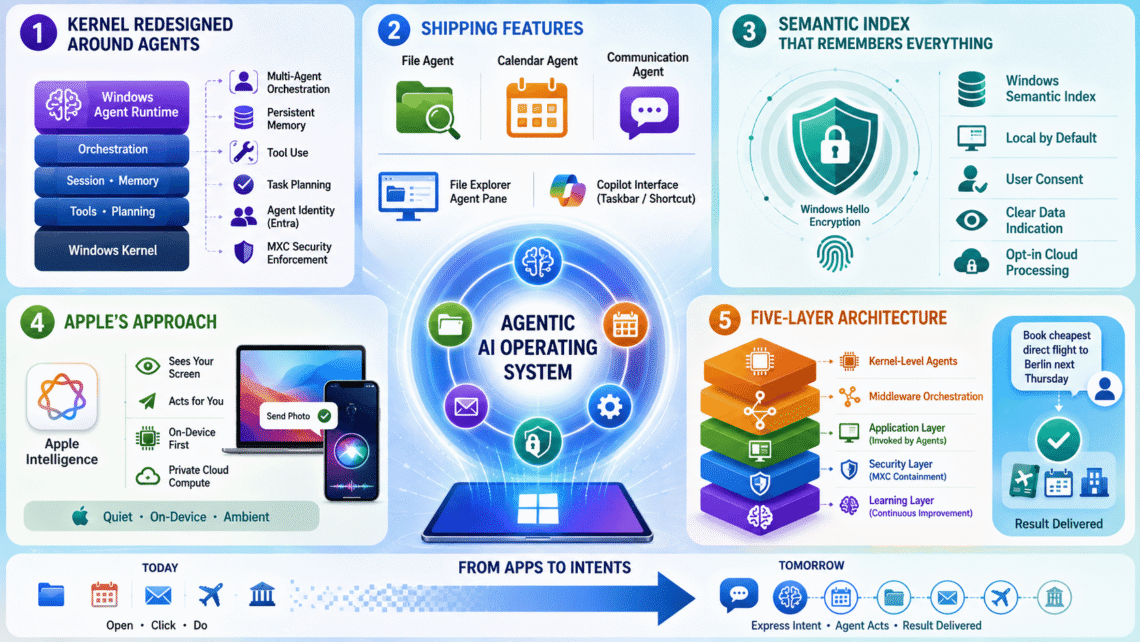
The single most significant technical shift underlying the current agentic AI operating system rollout is architectural rather than cosmetic. Microsoft is not simply adding a chatbot to the taskbar, as it did with earlier Copilot integrations that drew considerable user backlash. The company has embedded a new Windows Agent Runtime directly into the operating system, a system-level orchestration layer providing session management, persistent memory, task planning, tool use, and coordination between multiple simultaneous agents, all built directly into the OS itself rather than bolted on as a separate application. Windows chief Pavan Davuluri described the ambition explicitly, framing Windows as no longer a passive platform but an active participant in work and life.
The security architecture underlying this shift deserves particular attention, since it directly addresses the most obvious objection to an agentic AI operating system, that granting AI system-level access to files, applications, and hardware sounds catastrophically risky. Microsoft’s answer is a policy-driven execution layer called MXC, which allows developers to define precisely what any given agent can access, files, networking, system resources, specific applications, while Windows itself enforces those restrictions at the kernel level rather than trusting the agent’s own behavior.
Every agent operates under its own Entra-backed identity, isolated from the user’s desktop, clipboard, and input devices unless explicitly granted access, with all activity attributed and auditable. This containment model is what makes a genuinely agentic AI operating system plausible for enterprise and security-conscious users rather than remaining a novelty confined to consumer experimentation.
Two: File Organization and System Maintenance Are Already Shipping Features
The specific capabilities envisioned for a mature agentic AI operating system, automatically organizing files, searching content based on natural language rather than exact filenames, and handling routine system maintenance, are not purely speculative. They are shipping in early form right now. Microsoft’s initial release includes purpose-built agents for common tasks, a Calendar Agent, a File Agent, and a Communication Agent, accessible through an updated Copilot interface that can be pinned to the taskbar or summoned by keyboard shortcut. File Explorer itself now includes a dedicated agent pane offering real-time file analysis directly within the file browsing experience.
The longer-term vision Microsoft has articulated publicly for this agentic AI operating system extends considerably further than these initial agents. The stated ambition is a Windows that proactively manages routine computing tasks entirely on its own initiative, organizing photos without being asked, summarizing long email threads automatically, suggesting draft replies before the user has finished reading, and pre-loading applications based on the user’s own historical behavior patterns, anticipating what the user is about to need rather than waiting to be instructed.
This is precisely the file organization, content search, and predictive assistance envisioned as core functions of a genuinely intelligent operating layer, already moving from roadmap to early production release within a single calendar year.
Three: The Semantic Index That Remembers Everything, Carefully
For an agentic AI operating system to genuinely learn from user activity and act intelligently on the user’s behalf, it needs persistent memory of what the user has actually done, a capability that raises the sharpest privacy questions in this entire transition. Microsoft’s answer is the Windows Semantic Index, a personal semantic index encrypted specifically with Windows Hello biometric authentication, designed to enable persistent agent memory and context without simply storing a raw, unencrypted log of everything a user has ever done, a lesson learned directly from the well-documented privacy backlash surrounding the earlier Windows Recall feature.
The privacy framework attached to this memory layer is genuinely load-bearing for whether an agentic AI operating system can achieve mainstream trust rather than remaining confined to enthusiast early adopters. Microsoft has committed publicly to a strict user consent framework, with all data processing defaulting to local, on-device execution unless a user explicitly opts into cloud processing for a specific task, and clear visual indication whenever any agent touches personal data.
Whether this framework proves robust enough to satisfy privacy advocates and regulators once deployed at true consumer scale, well beyond the current early preview population, remains one of the most consequential open questions determining how quickly a genuinely agentic AI operating system reaches mass adoption.
Four: Apple Is Building the Same Vision Through a Different Door
Microsoft is not alone in pursuing this transition, and the contrast with Apple’s approach illustrates two genuinely different philosophies converging on a similar destination. Apple Intelligence, running largely on-device thanks to Apple’s own silicon, pursues a considerably quieter, more understated version of the agentic AI operating system concept, functioning less like a visible chatbot interface and more like an invisible extension of the existing interface itself.
Siri, in its current iteration, can genuinely see what is displayed on a user’s screen and act on it directly, sending a specific photo to a specific contact without the user needing to name the file or navigate to it manually, while most processing happens entirely locally, with cloud computation reserved specifically for the heaviest reasoning tasks through what Apple calls Private Cloud Compute.
This divergence between Microsoft’s visible, chat-forward agent interface and Apple’s quiet, embedded ambient intelligence represents two legitimate architectural bets on what an agentic AI operating system should actually feel like to use day to day, one that foregrounds the agent as a distinct entity the user directly converses with, and one that dissolves the agent so thoroughly into the existing interface that using it barely feels like invoking AI at all.
Which philosophy proves more durable and genuinely preferred by ordinary users, rather than power users and early technology adopters, will likely take several more product generations to determine conclusively.
Five: The Five-Layer Architecture Pointing Toward the OS Disappearing Entirely
Beyond the specific products currently shipping, researchers studying this transition have proposed a more general five-layer architectural framework for understanding where the agentic AI operating system concept is ultimately heading. Kernel-level agents handling low-level resource scheduling and hardware coordination, a middleware layer orchestrating communication between agents and system services, an application layer where traditional software still technically exists but is increasingly invoked by agents rather than directly by users, a security layer enforcing the kind of containment and permission boundaries Microsoft’s MXC system already implements today, and a learning layer that continuously refines the entire stack’s behavior based on accumulated user interaction patterns over time.
The genuinely speculative but technically coherent endpoint this architecture points toward is a computing experience in which the traditional application layer becomes almost entirely invisible to the ordinary user. Rather than opening a calendar application, a payment application, and a travel booking application separately to plan a trip, a user of a mature agentic AI operating system simply expresses an intent directly, book the cheapest direct flight to Berlin next Thursday, and the underlying agentic layer interprets that intent, coordinates every necessary service automatically behind the scenes, and delivers a completed result.
The application layer continues existing beneath this interaction, but the user increasingly interacts with the agent interface itself rather than navigating between individual applications one at a time, a genuine inversion of four decades of established computing convention.
What Remains Genuinely Uncertain
A rigorous, hype-free assessment of the agentic AI operating system concept requires being explicit about what remains unresolved rather than treating this transition as a foregone conclusion. Early real-world testing has already surfaced rough edges, one prominent technology journalist reported his own Scout agent, Microsoft’s always-on Copilot agent, sending an email composed as a single unformatted run-on sentence, a small but telling reminder that autonomous execution without adequate human review still carries genuine, practical failure modes well short of any catastrophic scenario.
Security researchers have specifically emphasized that continuously running local agents require carefully intentional isolation, since developers and users alike need genuine, verifiable control over exactly what any given agent can access, and confidence that those specific controls will actually hold under real-world conditions rather than merely on paper.
Standardization across the industry represents a further genuine obstacle. For an agentic AI operating system on one device to coordinate meaningfully with an agent running on a user’s phone or within a separate smart home ecosystem built by an entirely different company, the industry needs shared, interoperable protocols, an challenge directly analogous to the Model Context Protocol standardization discussed extensively elsewhere on this blog, extended now to the considerably higher-stakes context of operating system level agent coordination across competing vendors with genuinely divergent commercial incentives.
Conclusion
The agentic AI operating system is not a distant, purely speculative vision confined to research papers and product roadmaps. It is a concrete architectural shift already embedded directly into the Windows kernel, shipping in early form to real users, and being pursued through a parallel but philosophically distinct path by Apple simultaneously. File organization, proactive system maintenance, and natural language content search, the specific capabilities this article set out to examine, are already moving from aspiration to early production reality within a single calendar year, considerably faster than most observers would have predicted even eighteen months ago.
What remains genuinely open is not whether an agentic AI operating system arrives, but rather how quickly it matures past its current, occasionally rough early implementation, how convincingly the privacy and containment framework holds up once deployed at true mass scale, and how thoroughly the traditional application layer that has defined computing since the earliest graphical interfaces ultimately recedes behind an intelligence layer that, for the first time in computing history, is designed to act on a user’s behalf rather than simply waiting patiently to be told exactly what to do next.


You May Also Like
The Critical Future of LLM Technology: A Hype-Free Forecast for the Next Five Years (Part 2)
The Critical Truth About LLM Development History: A Decade of Progress Without the Hype (Part 1)