Enterprise AI
Insights on AI strategy, AI governance, agentic systems, MLOps, and enterprise deployment.
-
Google’s Powerful Gemini 3.6 Flash: 5 Ways It Is Transforming Enterprise AI Compute Costs
A Quiet Launch with Loud Implications
There was no keynote. No countdown. No breathless livestream. On July 21, 2026, Google quietly released three new AI models: Gemini 3.6 Flash, Gemini 3.5 Flash-Lite, and Gemini 3.5 Flash Cyber. The announcement was measured in tone, focused on efficiency rather than spectacle, and aimed squarely at one audience: enterprises and developers running AI agents in production who are watching their monthly API bills with growing alarm.
That framing tells you exactly what the Gemini 3.6 Flash compute costs story is actually about. It is not a capability race announcement. It is a cost engineering announcement, and for any organisation deploying AI at scale, the implications are significant enough to warrant immediate attention.
What Gemini 3.6 Flash Actually Is
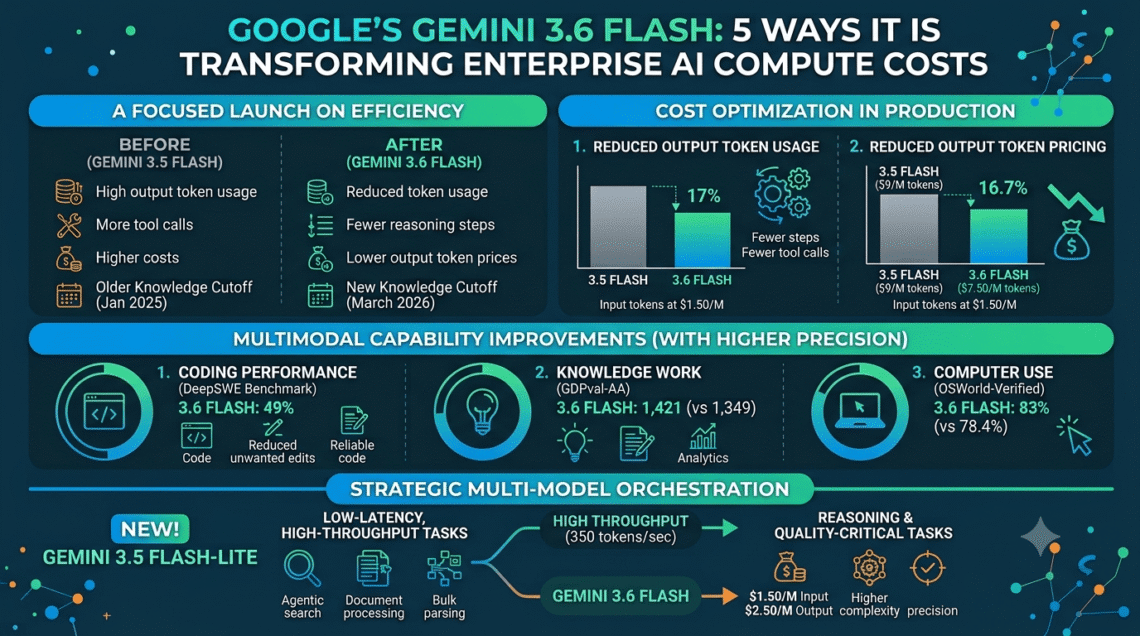
Gemini 3.6 Flash is Google’s updated workhorse Flash model, delivering better coding, knowledge work, and multimodal performance than its predecessor, Gemini 3.5 Flash. The headline efficiency improvement is a 17% reduction in output token usage compared to 3.5 Flash, achieved by taking fewer reasoning steps and tool calls to accomplish multi-step workflows.
For enterprises thinking about Gemini 3.6 Flash compute costs, the pricing structure makes immediate sense. While input tokens remain at $1.50 per million, output tokens dropped to $7.50 per million, down from $9 per million on 3.5 Flash. That is a 16.7% reduction in output token pricing combined with a 17% reduction in the number of output tokens generated. For high-volume production deployments, the combined effect compounds into meaningful cost savings.
On coding performance, Gemini 3.6 Flash delivers higher precision with fewer unwanted code edits and reduced execution loops, and generates higher quality, more reliable, production-ready code as seen in the DeepSWE benchmark, scoring 49% versus the predecessor’s lower figure. For knowledge work, the model scores 1,421 on GDPval-AA compared to 1,349 for 3.5 Flash. Computer use capabilities advance from 78.4% on OSWorld-Verified to 83%.
The knowledge cutoff date also finally advances from January 2025 to March 2026, which matters practically for enterprise deployments where outdated knowledge has been a persistent source of model errors in production.
The Flash-Lite Dimension: Compute Costs at Volume
Alongside Gemini 3.6 Flash, Google released Gemini 3.5 Flash-Lite, a model specifically designed for high-throughput, low-latency tasks such as agentic search and document processing. Flash-Lite is priced at $0.30 per million input tokens and $2.50 per million output tokens, making it one of the most affordable production-grade models available from a frontier AI provider.
Flash-Lite pushes throughput to 350 output tokens per second for high-volume pipelines, a figure that matters enormously for enterprises running document processing, retrieval-augmented generation at scale, or multi-agent workflows where thousands of simultaneous requests are the norm rather than the exception.
The release slots into the existing lineup with 3.6 Flash replacing Gemini 3.5 Flash as the default mid-tier model, while Flash-Lite serves bulk parsing and per-task fan-out roles where cost per operation matters more than reasoning depth. For AI engineers designing multi-model orchestration pipelines, this creates a clear routing logic: use Flash-Lite for high-volume, lower-complexity tasks and 3.6 Flash for the steps where reasoning quality and output accuracy are critical.
Why Enterprise AI Compute Costs Have Become a Crisis
The Gemini 3.6 Flash compute costs story cannot be understood in isolation from the broader crisis it is responding to. Enterprise AI spending has reached a scale that is generating serious CFO attention. These releases prioritise cost efficiency as companies face rising token costs from running AI agents at scale.
The economics are stark. A mid-sized enterprise running five AI agents simultaneously, each handling hundreds of daily multi-step workflows, can easily accumulate millions of output tokens per day. At $9 per million output tokens, a single reasonably active agent deployment can cost tens of thousands of dollars per month before any infrastructure overhead is added. Multiply that across an enterprise with dozens of agent deployments, and the annual AI inference bill becomes a significant budget line item that competes directly with headcount, licences, and capital expenditure.
The problem is compounded by what engineers call token inflation in agentic systems. Each tool call an agent makes generates reasoning tokens as it decides what to do next, tool call tokens as it formats the request, and response tokens as it processes the result. In a ten-step agentic workflow, the visible output is a fraction of the total token consumption. A model that takes fewer reasoning steps and emits fewer tokens per task is cheaper even at the same per-token price, and Gemini 3.6 Flash cuts the per-token price too. These two improvements together address the inflation problem directly.
The Competitive Context: Pressure Across the Industry
Google’s Gemini 3.6 Flash compute costs announcement does not exist in a vacuum. It is part of an accelerating price war among frontier AI providers that is, counterintuitively, beneficial for enterprise buyers. OpenAI’s GPT-4o mini, Anthropic’s Claude Haiku 3.5, and Meta’s Llama 3.1 8B (available as a self-hosted open-weight model at near-zero per-token cost) have all pushed the market toward the conclusion that inference efficiency is now the primary competitive battleground for the workhorse model tier.
The Chinchilla scaling law insight from Part 4 of our LLM series is relevant here: smaller, well-trained models consistently outperform larger undertrained ones at equivalent compute budgets. The Flash model family is the commercial embodiment of this principle. Flash offers pro-level intelligence at Flash speed and low cost, a claim validated in actual benchmark testing, and may actually outperform larger models in automation tasks, code generation, and multi-turn conversations.
For enterprise architecture teams, this creates a genuine strategic decision point. The cost gap between frontier reasoning models and efficient workhorse models has widened to the point where deploying a frontier model for every task is not just expensive but unnecessary. The right architecture routes tasks to the cheapest model capable of handling them reliably, a principle that Gemini 3.6 Flash compute costs now make financially compelling for the largest category of production workloads.
The Gemini 4 Signal
Google also confirmed that it has started pre-training Gemini 4, and that Gemini 3.5 Pro will be made available broadly soon. The signal for enterprise planning is clear: the Gemini model family is accelerating its release cadence, with new generations arriving faster than the annual cycles that characterised earlier AI model releases.
For procurement and architecture teams, this creates a planning challenge. Organisations that hard-code a specific model version into their production pipelines will face increasing maintenance overhead as preferred models are deprecated. The recommendation from API integration specialists is to evaluate Gemini 3.6 Flash now but retain Gemini 3.5 Flash or another proven route until a workload-level canary test passes, ensuring that the efficiency improvements deliver their expected savings in your specific production environment before full migration.
What This Means for Enterprise AI Strategy
The Gemini 3.6 Flash compute costs story points toward five concrete implications for enterprise AI teams.
First, audit your current token consumption by workflow step. The biggest Gemini 3.6 Flash compute costs savings come from identifying the steps in your agentic pipelines where token inflation is highest and migrating those specifically.
Second, adopt a tiered model routing strategy. Flash-Lite for bulk processing, 3.6 Flash for reasoning-intensive tasks, and frontier models only where their specific capabilities are demonstrably necessary.
Third, benchmark before migrating at scale. The 17% token reduction is a headline figure measured on Google’s benchmark suite. Your production workload will produce a different number, which may be higher or lower.
Fourth, model Gemini 4 into your planning horizon. With pre-training confirmed, a Gemini 4 Flash release is likely within the next twelve months, and the pricing and capability curve suggests further Gemini 3.6 Flash compute costs reductions are coming.
Fifth, treat inference cost as a first-class engineering metric. The organisations that will extract the most value from the current generation of efficient AI models are those that instrument their token consumption the same way they instrument latency and error rates.
Conclusion
Google’s Gemini 3.6 Flash is not a headline model. It is an infrastructure model, designed to make the AI agents that enterprises are already running cheaper, faster, and more reliable at scale. In a market where Gemini 3.6 Flash compute costs are generating serious boardroom attention, a 17% token reduction combined with a lower per-token price is exactly the kind of announcement that matters most to the people actually paying the bills.
The AI capability race is real and ongoing. But in 2026, the race that matters most for enterprise deployment is the efficiency race — and Google just moved significantly ahead.
-
The Governance Imperative: Why Agentic AI Deployment Is Outpacing Enterprise Readiness
From Pilot Fatigue to Production Reality
Enterprise AI has crossed a threshold. Gartner forecasts that 40% of enterprise applications will embed task-specific AI agents by end of 2026, up from under 5% in 2025. That is not incremental adoption, it is a structural reconfiguration of how enterprises orchestrate work. The transition from isolated generative AI experiments to production-grade, multi-agent architectures is no longer a roadmap item. It is happening now, unevenly, and largely ahead of the governance frameworks designed to contain it.
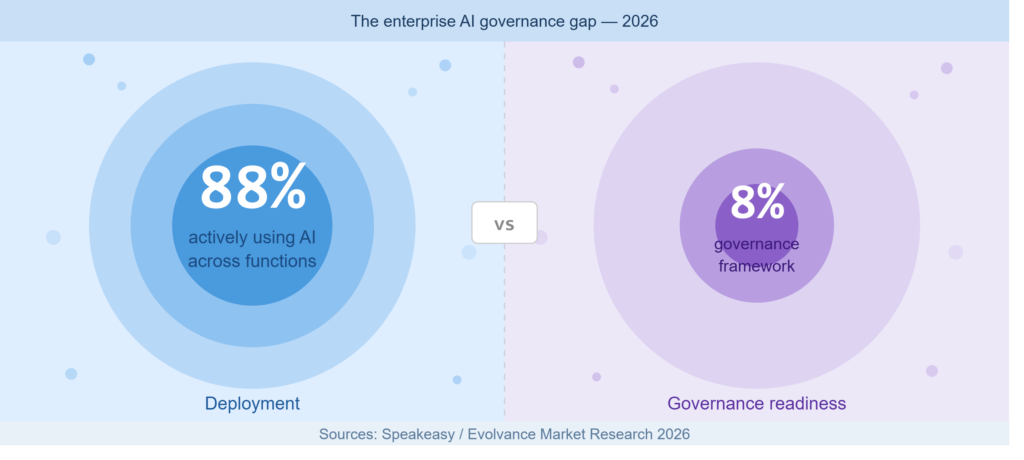
The numbers are unambiguous about the asymmetry. Only 8% of organisations globally have a comprehensive AI governance framework, while 88% are actively using AI across business functions. That eighty-point gap is not a compliance footnote but the operating risk profile of most enterprises deploying agentic systems today.
The Governance Gap Is a Performance Variable, Not a Compliance Checkbox
Enterprise leaders who still frame AI governance as a risk management exercise are misreading the data. Companies using AI governance tools get over 12 times more AI projects into production. Organisations that use evaluation tools move nearly six times more AI systems to production. Governance, in other words, is the primary determinant of deployment velocity, not a constraint on it.
PwC research finds that 74% of all AI-generated economic value is captured by just 20% of organisations, and those AI leaders invest in governance infrastructure at rates significantly higher than the market average. The value concentration this represents is not coincidental. Mature governance programs eliminate the rework cycles, incident responses, and regulatory interventions that bleed velocity from under-governed programs.
The EU AI Act’s full enforcement provisions for high-risk AI systems take effect August 2, 2026, covering credit scoring, employment decisions, and insurance underwriting, with fines reaching €15 million or 3% of global annual turnover for non-compliance. For heavily regulated industries, this regulatory pressure compounds what is already an operational imperative.
Agentic Architecture Introduces an Entirely New Attack Surface
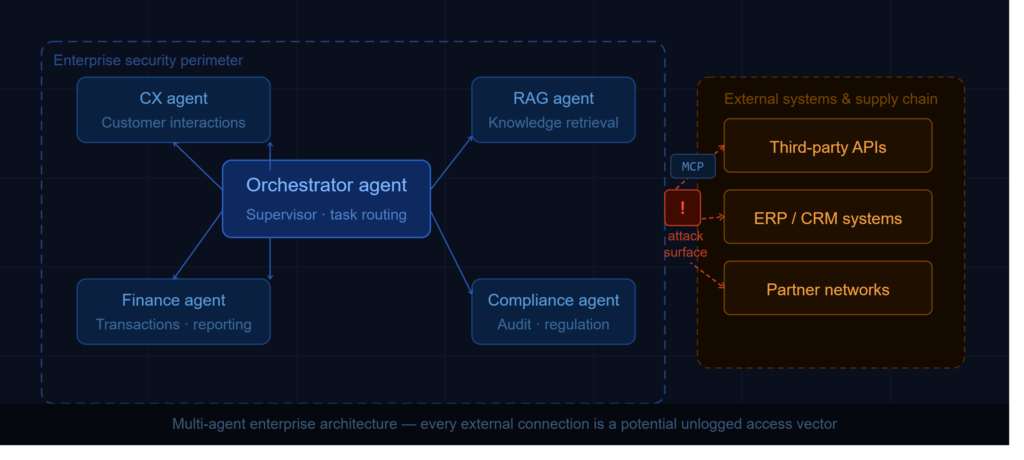
The shift to multi-agent systems does not merely scale existing risk. It introduces qualitatively new categories of it. Agents have identity, privileges, and access to systems and data across the business and out into the extended supply chain, either directly or through interfacing with other agents indirectly. This makes them a new and unexplored security risk, which is an entirely new non-deterministic attack surface.
The NSA released MCP security guidance in May 2026, signaling that federal regulatory requirements are a matter of when, not whether. The Model Context Protocol, which has rapidly matured into a common foundation for agent-to-tool connectivity, enables agents to interact with tools and data sources through standardised interfaces, a vital step toward portability, security, and observability. But standardisation alone does not constitute governance.
Uber’s deployment at scale offers the most instructive production case study available. By early 2026, 84% of Uber’s developers were using agentic coding tools daily, with AI generating between 65% and 72% of all code written inside their IDEs. Uber reached that scale because it built three governance layers before scaling adoption: an LLM gateway handling PII redaction, access control, and audit logging across every model interaction; an MCP gateway governing every agent-to-tool connection across 10,000+ internal services; and an agent identity system extending Zero Trust infrastructure to multi-agent workflows. The sequencing matters: governance infrastructure preceded scale, not the other way around.
Vendor Architecture Is a Strategic Decision, Not a Procurement Decision
Choosing an agentic AI vendor in 2026 is a different kind of decision. The model you select shapes how your agents reason, what they can and cannot do, how your data is handled, and how deeply you become entangled in a vendor’s ecosystem.
The compounding lock-in risk deserves particular attention. If agents run on a vendor’s proprietary orchestration layer, lock-in compounds at every layer of the stack. Enterprises that have not yet defined their agentic AI architecture strategy are already making a default choice. And that default is usually determined by whichever vendor has the best marketing rather than the best governance posture.
Sovereign AI considerations are now reshaping vendor selection in regulated industries. Sovereignty spans infrastructure, security, governance, lifecycle management, hiring policies, supply chains, service contracts, and partnerships, well beyond a one-time infrastructure decision. For European enterprises in particular, open-weight models with EU jurisdictional alignment offer a combination of flexibility and data sovereignty that hyperscaler-tied deployments cannot match.
What Separates Scaling Organisations from Those That Stall
Only 25% of AI initiatives deliver expected ROI, and only 16% reach enterprise-wide scale. Gartner expects over 40% of agentic AI projects to be cancelled by end of 2027 due to with escalating costs, unclear business value, and inadequate risk controls cited as primary drivers.
The distinguishing variable across the data is consistent: enterprises where senior leadership actively shapes AI governance achieve significantly greater business value than those delegating the work to technical teams alone. Governance, in the highest-performing organisations, is not a CISO concern or a legal review but a board-level operating discipline.
For enterprise AI leaders, the strategic question in the second half of 2026 is no longer whether to deploy agentic systems. It is whether the governance, evaluation, and observability infrastructure already in place is commensurate with the autonomy being granted. The organisations that answer that question honestly (and close the gap before scaling further) are precisely the ones that will capture the disproportionate share of value the data consistently points to.